
In a geometry textbook, two points are enough to define a straight line. In experimental science, the minimum is six. This is not a matter of convention — it follows from the mathematics of linear regression itself.
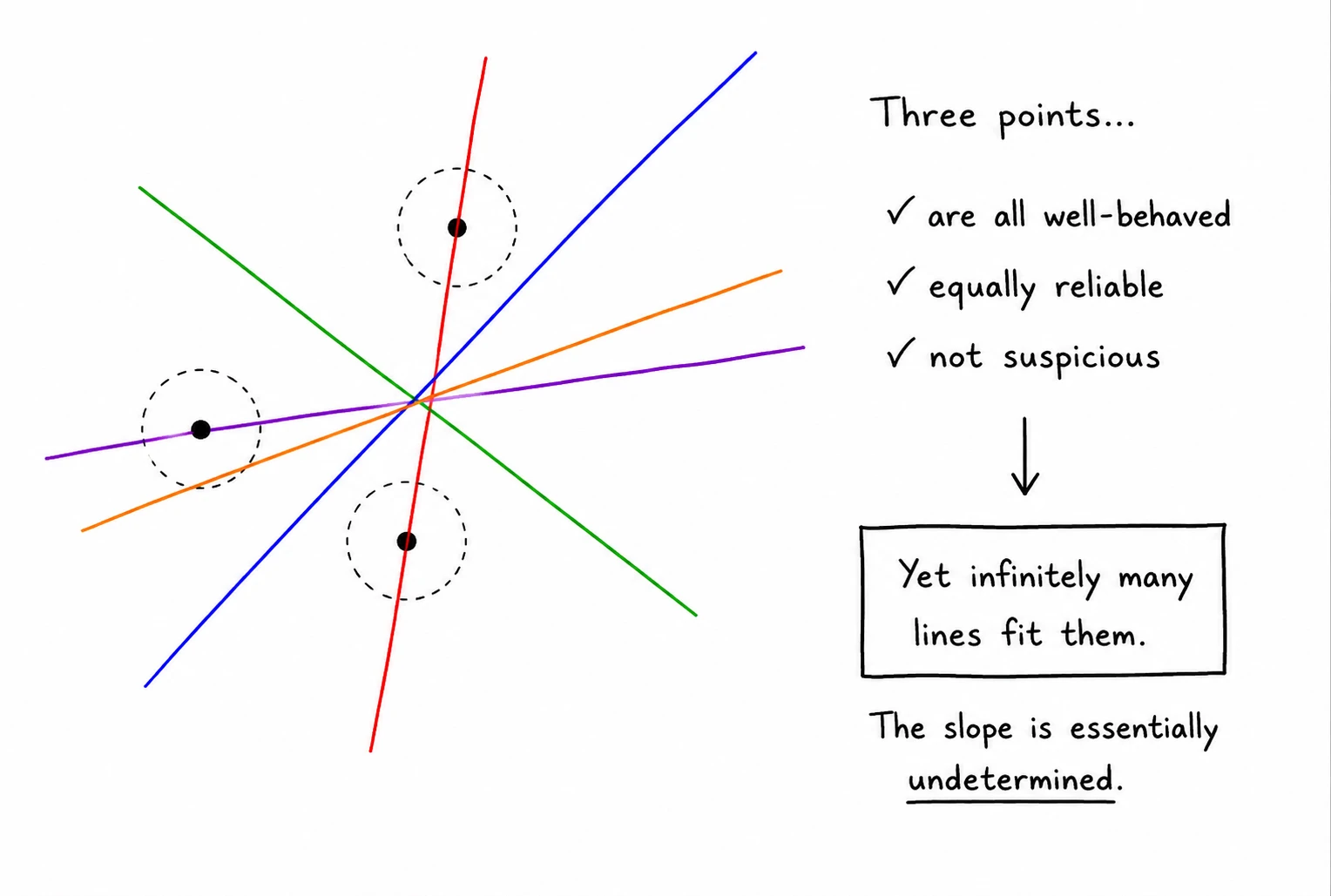
With three points, you can fit a statistically respectable straight line in almost any direction you choose. Not because one point is suspicious or anomalous — three perfectly well-behaved, equally reliable points can still leave the slope essentially undetermined. The data are simply insufficient to constrain the fit.With four points, your freedom narrows, but not nearly enough. Six points is where a linear fit starts to become honest: the line goes where the data send it, not where you’d like it to go.
 For a curved relationship — an exponential, a power law, a parabola — the threshold is higher. A clean, well-behaved curve of a single functional form needs at least twenty points to be trustworthy. Fewer than that, and you’re not fitting a curve; you’re fitting your expectations.
The practical implication: before you run an experiment, count the points you plan to collect. If the answer is “five,” go back and redesign. Your committee will thank you. More importantly, you’ll be able to defend what you found.
For a curved relationship — an exponential, a power law, a parabola — the threshold is higher. A clean, well-behaved curve of a single functional form needs at least twenty points to be trustworthy. Fewer than that, and you’re not fitting a curve; you’re fitting your expectations.
The practical implication: before you run an experiment, count the points you plan to collect. If the answer is “five,” go back and redesign. Your committee will thank you. More importantly, you’ll be able to defend what you found.